IndexPDF journal
Why an Author Index Is an Identity Problem, Not a Name Search
Learn why author indexes must distinguish people, reconcile citation forms with bibliography context, and leave ambiguous or passing mentions for review.
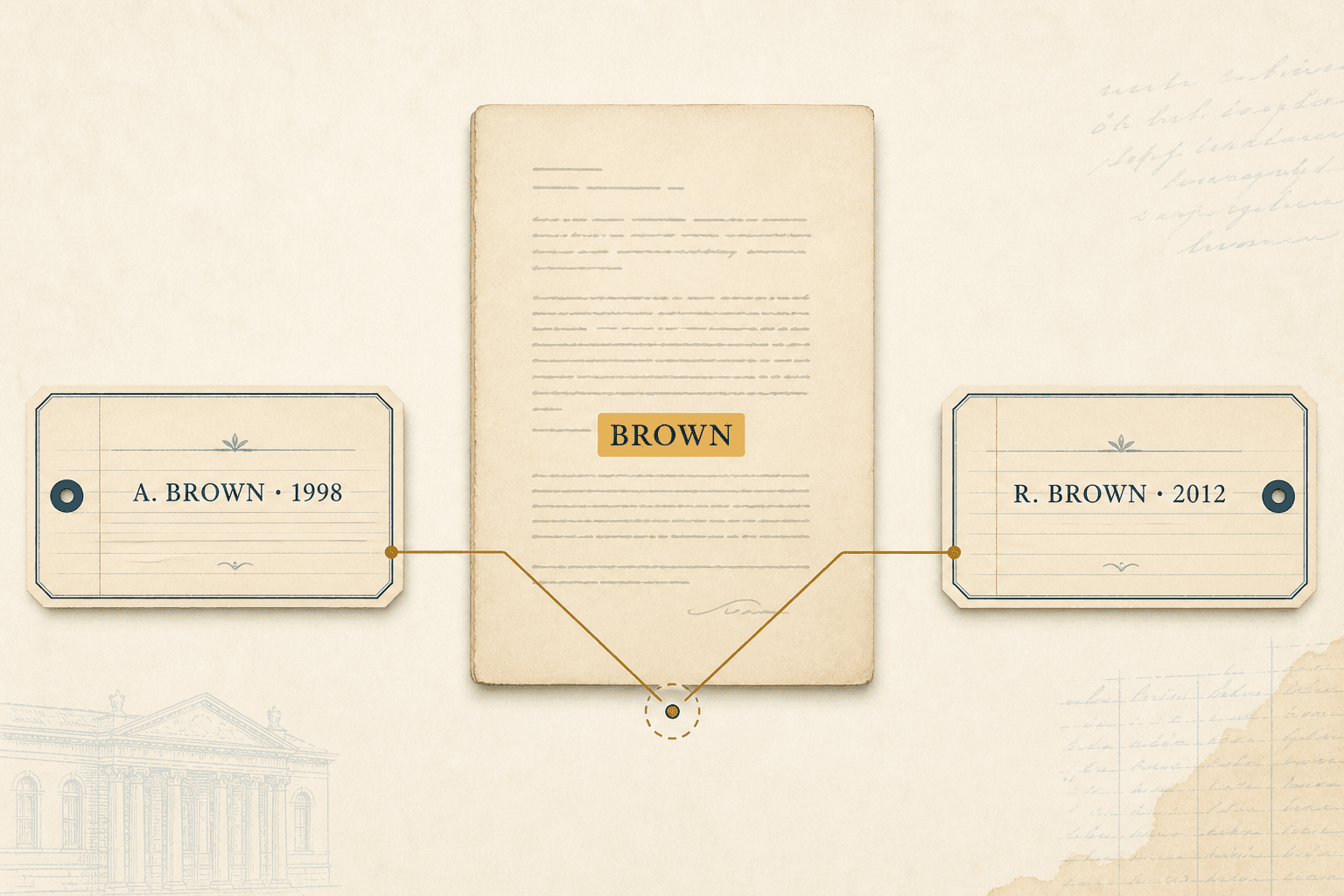
An author index must resolve identities, reconcile name variants with bibliography evidence, and decide which mentions give readers useful access.
Suppose Alexander appears three times in a scholarly book. In one passage, Priya Alexander argues for a revised date. Another discusses Alexander the Great. A third includes the title Xerxes and Alexander. Search finds three strings. An author index may need only one.
A printed name is not a stable identifier. It may be a full name, initials, a surname, part of another person's name, or a word in a title. One person may appear under several forms; several people may share one. Finding the characters on the page is only the beginning.
A reliable workflow separates three questions
A reliable author-index workflow separates three questions:
- Occurrence: Does this span refer to a person covered by the index?
- Identity: Which person does the printed form denote here?
- Inclusion: Does this occurrence deserve a locator under the publication's author-index policy?
Each decision can fail independently. A system can find Brown but mistake a color for a person. It can recognize a person but merge Alice Brown with Andrew Brown. It can identify Alice Brown correctly but index a passing citation that offers readers no useful access.
Search helps generate candidates. It cannot turn those candidates into a publishable author index by spelling alone.
Name variants are evidence, not identity
Scholarly prose rarely names one person consistently. A bibliography may print “Brown, Alice M.” while the body uses “Alice Brown,” “A. M. Brown,” “Brown,” or “Brown et al.” An author index usually needs one consistent display form even though its locators arise from several printed forms.
Normalization makes those forms comparable by regularizing case, spacing, punctuation, and inversion. It does not prove identity. Alice Brown and Andrew Brown remain different people even when both appear as “A. Brown.” Safe normalization groups evidence for review; unsafe normalization turns resemblance into a silent merge.
The bibliography adds context, not entries
Bibliography context can make an abbreviated citation more informative. If the bibliography contains works by Alice Brown from 1998 and Robert Brown from 2012, “Brown (1998, 44)” favors one identity. A title, year, given name, role, or coauthor can narrow the candidates further when the passage actually connects that evidence to the occurrence.
The underlying records must preserve those relationships. Editors, translators, and compilers should remain connected to their roles. Coauthored works should retain multiple contributors. A repeated-author dash should inherit the correct contributor rather than create an unnamed one.
Bibliographic clues are not universally unique. Two people can publish in the same year. Titles can be reused, shortened, or translated. A citation may omit the one detail needed to distinguish two contributors.
Four useful review tests
Four patterns make useful review tests:
- False occurrence: “Brown is the color of the outer layer” should not become a person entry.
- Longer referent: “Alexander the Great” should not be shortened to a contributor named Alexander.
- Shared evidence: If two Browns have compatible works from 1998, the year does not resolve the identity.
- Missing bibliography: “Jane Smith argues…” remains a real, located mention even when no bibliography record supplies a fuller identity.
These cases require different outcomes: reject the false occurrence, preserve the complete referent, keep multiple candidates open, or retain a document-supported mention for review. A single “matched” flag hides the distinction.
Identity is not inclusion
Even a perfectly identified citation may not belong in the final index. Some publications include every cited scholar in the body and notes. Others retain only substantive discussion, critique, comparison, or attribution.
Length is not a reliable proxy. A brief attribution may identify the source of a central argument; a long note may merely inventory background literature. The useful question is whether the passage gives the reader a meaningful route into the book.
That policy should be set before individual locators are approved. A clear publisher workflow defines the audience, scope, treatment of passing citations, and naming rules first so reviewers apply the same standard throughout the book.
Keep the evidence beside the decision
An identity decision should remain connected to the passage that produced it. For each candidate, a reviewer should be able to inspect:
- the printed form and surrounding passage;
- the proposed identity and display form;
- the bibliography evidence used to reconcile it;
- the page locator; and
- the reason the occurrence is included or excluded.
That evidence supports the corrections that matter: confirm an identity, keep two people separate, merge true variants, reject a false match, change the display form, or remove a passing citation.
Uncertainty should change review priority, not disappear behind polished output. A surname compatible with several contributors deserves closer attention than an unambiguous full name. A document-supported mention can remain useful even when the bibliography is absent, provided its unresolved status remains visible.
What IndexPDF adds
IndexPDF's private beta creates bibliography-aware author-index drafts from final paginated PDFs for citation-heavy scholarly and theological publishing. It uses bibliography context to expand names and reconcile citation forms without treating the bibliography itself as indexable prose. Each candidate remains beside its source passage and page so the reviewer can resolve identity, choose a display form, judge significance, and verify the locator.
The product advantage is not finding names; ordinary search can do that. It is turning thousands of identity and inclusion judgments into an evidence-grounded review workflow without hiding ambiguity or separating a proposed entry from the page that supports it.
Questions to ask any author-indexing workflow
- Does it separate occurrence, identity, and inclusion?
- Does it use bibliography context without populating the index from the bibliography?
- Can it keep same-surname and same-name people separate when the evidence is insufficient?
- Does it preserve roles, coauthors, and repeated-author conventions?
- Can valid document mentions survive an absent or incomplete bibliography?
- Can a reviewer inspect the exact passage and locator before approving a suggestion?
- Does the publication, rather than the software, control passing-citation policy?
An author index is more than a name search
A name search produces a concordance of strings. An author index requires judgments about people, variants, works, and the value of each locator to the reader. The strongest workflow preserves what is known, exposes what remains uncertain, and gives the responsible reviewer enough evidence to decide.