IndexPDF journal
Why Scripture Indexing Is More Than Finding Chapter and Verse
Professional Scripture indexing combines automated citation detection, contextual resolution, house-style normalization, and publication-configured organization.
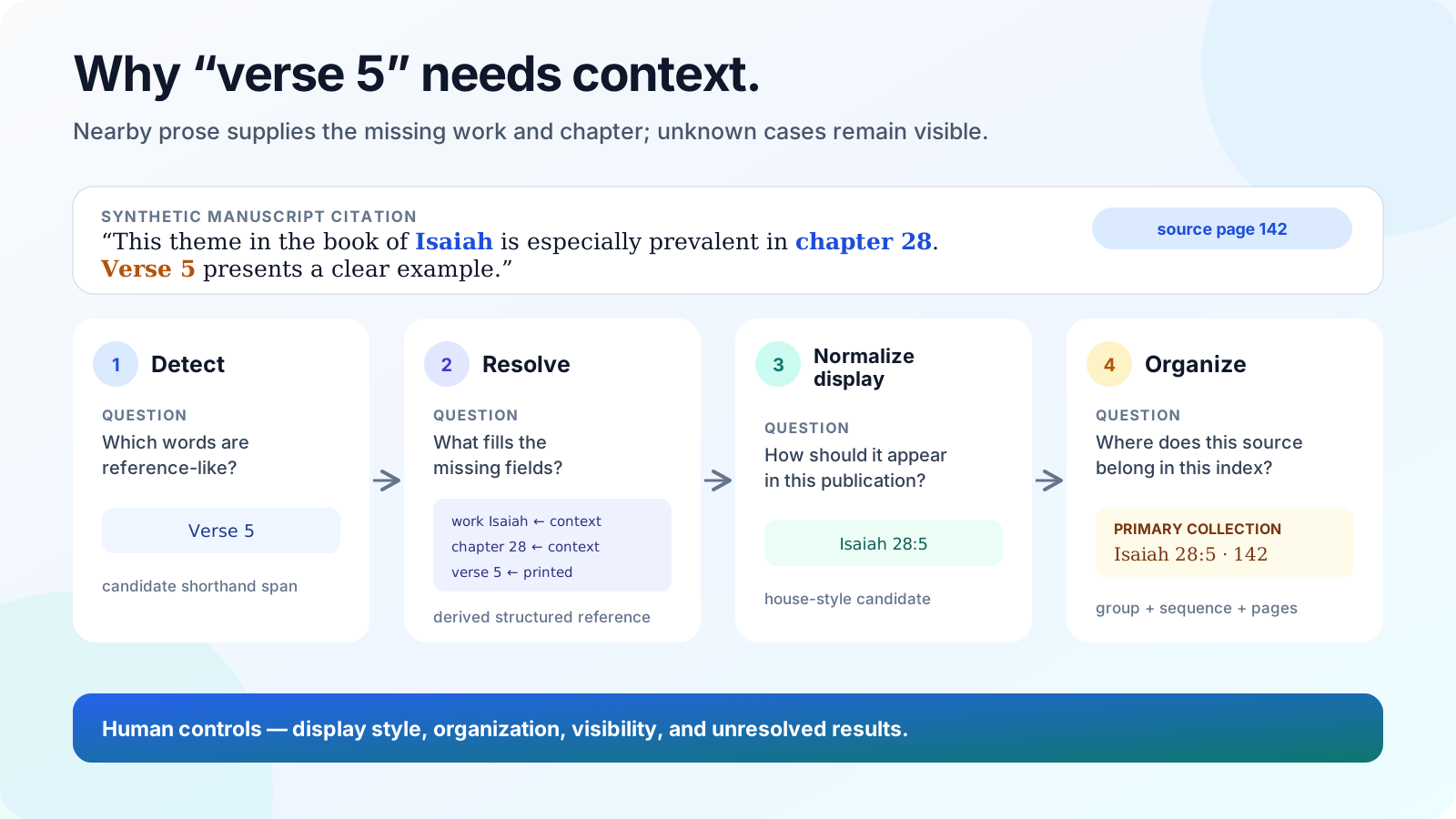
Professional Scripture indexing separates automated citation detection, contextual resolution, house-style normalization, and publication-configured organization. Human control focuses on display, organization, inclusion, and unresolved results.
A Scripture index can look simple: find a book, chapter, and verse; arrange the references in canonical order; add the pages on which they occur. That works until a manuscript gives you “Gen 1:20–2:4,” “Isa 28:10, 13,” or a bookless “(25:25–55)” whose source must be inferred from the sentence.
The hard part is not finding digits and punctuation. It is preserving what the text says while making a sequence of evidence-dependent editorial decisions. A system may detect a reference-like span without knowing which work it cites. It may resolve the work without knowing the publisher's preferred display form or where that work belongs in this book's index.
Collapsing those questions produces false precision. A reliable workflow keeps them separate and makes uncertainty reviewable—especially in scholarly and theological books that require coordinated subject, author, and Scripture indexes.
Four operations inside the Scripture-indexing pipeline
IndexPDF performs these operations automatically. Editors configure the publication-facing choices and can intervene when a reference remains unknown or should not be displayed.
- Detect: Is this span reference-like? Preserve the exact source text and parse only the locator structure the evidence supports.
- Resolve: Which work does it identify? What context does shorthand inherit? If the evidence is insufficient, keep the work or locator unresolved.
- Normalize: How should the reference appear under this publication's style? Apply the approved work name, abbreviation, punctuation, and range form without erasing the printed form.
- Organize: Where should the work appear in this index? Apply the publication's selected groups, labels, and sequence rather than assuming one universal canon.
Each operation produces structured evidence. When the pipeline cannot justify a work or locator, it preserves an unknown state instead of guessing; an editor can then resolve or retain it.
Detection must preserve reference structure
Scripture references may name a whole work, chapter, verse, verse range, chapter range, or range crossing a chapter boundary. They may use abbreviations, dotted notation, or lists joined by commas and semicolons. A parser does not need to support every historical or house-specific convention to be useful, but it must not erase distinctions it can establish.
“Gen 1:20–2:4” is one continuous range across two chapters. “Gen 31:1–8, 14–15, 23” is three discontinuous segments. Converting the latter to “Gen 31:1–23” would claim that verses 9–13 and 16–22 were cited when they were not. “Deut 1:5; 4:44; 6:1” likewise contains three references to one named work, not one range.
The exact source span must remain connected to its location on the page. That evidence is available when a result is surfaced as unknown or an editor chooses to inspect it—for example, to determine whether punctuation belongs to the citation, whether a superscript marks a note rather than a verse, or whether a line break separated the work name from its locator. Structured data should make the evidence easier to inspect, not hide it.
Shorthand is resolved from context
In “Isa 28:10, 13,” the second number can inherit Isaiah 28 from the immediate citation. That inheritance is local: an unrelated “13” elsewhere on the page must not become Isaiah 28:13 merely because its typography matches.
Likewise, “Lev 25:8–24” followed closely by “(25:25–55)” provides a defensible parent for the bookless range. A distant parenthetical reference—or one following several named books—may need to remain unresolved. Unknown is not a failed output. It identifies the decision a reviewer still needs to make.
Resolution must also distinguish collections from their constituent works. A generic collection label followed by “19:16” is not enough to assign a verse-level reference to a particular book. The work must be established from context or sent to review.
Resolution is not yet house style or organization
A resolved reference is not yet ready for publication. The index still needs a house style and an organization policy.
One publication may prefer “Song of Solomon,” another “Song of Songs,” and another “Shir HaShirim.” The underlying work can retain one stable identity while the finished index selects an approved label. The same separation allows one project to place Tobit within its primary sequence and another to group it outside that selected collection. This is an organizational decision, not a universal judgment about canonical status.
The distinction also matters for sources with several useful scholarly groupings and for aliases shared by more than one work. If the context supports a corpus but not a unique work, the responsible result is an explicit ambiguity—not a guessed identity.
No preset can settle every theological or editorial question. Canon contents, order, integrated additions, names, abbreviations, and versification vary by tradition and edition. A publication profile should therefore be configurable and approved against the publisher's specification.
Interpretation and versification remain editorial
Finding an explicit citation does not establish that it belongs in the index. The publisher may include every occurrence, exclude certain notes or tables, or require editorial judgment about substantive use. Allusions are a separate interpretive problem and should not be conflated with explicit-reference detection.
Alternate versification also requires a stated policy. Converting between numbering systems may demand edition-specific data and specialist review; it should never be presented as a universally automatic normalization.
Unknown results and publication controls
A useful review queue distinguishes among unresolved work identities, incomplete chapter-and-verse hierarchies, shared aliases, unsupported range endpoints, and resolved sources that lack an approved placement. A generic warning tells the reviewer that something is wrong. A structured uncertainty state tells the reviewer what to fix.
Priority review can bring detected unknown or unassigned results forward. Editors also control the organization profile and which results appear in the index. An unflagged result is pipeline output, not a claim of universal correctness; the publisher can apply whatever broader review policy the book requires. IndexPDF's source-page verification workflow keeps each proposed reference connected to the passage and page on which it was found.
The finished index has two locator systems
Readers need consistent work labels, meaningful group headings, an approved sequence, correctly ordered scriptural locators, and accurate document-page locators.
Those two locator systems perform different jobs. In an entry such as “Isaiah 28:10, 13 — 142, 157,” the first numbers identify passages in Isaiah; the second tell the reader where the present book discusses them. If several occurrences normalize to the same scriptural locator, their document pages can be gathered under one entry.
Before publication
- Confirm which occurrences are in scope; do not equate detection with significance.
- Resolve or deliberately retain every incomplete, bookless, or ambiguous reference.
- Preserve discontinuous segments and verify every range endpoint.
- Approve work names, abbreviations, punctuation, range style, and versification policy.
- Verify grouping and sequence against the publication specification.
- Sort chapters and verses numerically, not as text strings.
- Check every document-page locator against the final proofs.
- Remove empty headings and resolve—or intentionally retain—any Other or Unassigned group.
- Obtain final approval from the responsible author, editor, publisher, specialist, or professional indexer.
A reviewable assisted workflow
IndexPDF automatically separates discovery, contextual resolution, display normalization, and organization. Editors configure organization and display, decide what remains visible, and resolve results the pipeline leaves unknown. Source evidence remains available without turning every routine result into a manual review task.
That workflow supports compact references and related textual corpora without pretending that software can recognize every form, resolve every ambiguity, or make every canonical decision. Detection can miss unfamiliar conventions. Allusions, alternate versification, notes, tables, suffixes, compressed lists, and tradition-specific practices may require house policy and specialist judgment. The person approving the index remains responsible for the version sent to print.